
Opening a Coffee Shop or Restaurant in Malta?
Everything you need to know before your first cup goes across the counter
Opening a coffee shop or restaurant in Malta is exciting. The concept is ready, the menu is taking shape, the interiors look beautiful in your head. And then someone asks: “So, what espresso machine are you getting?”
That’s when it gets real.
We’ve been supplying coffee equipment across Malta since 2013. We’ve helped launch specialty coffee shops, neighbourhood spots, busy restaurants, hotel lobbies, and office kitchens. Some went smoothly. Others… let’s just say they taught us all a few things about planning ahead.
This guide is everything we wish every new coffee business owner in Malta knew before they started. No sales pitch — just the honest, practical stuff that saves you time, money, and a lot of stress.
First Things First: What Kind of Coffee Business Are You?
This sounds obvious, but it’s the question that determines everything — machine size, grinder type, budget, and timeline. The equipment needs of a high-volume specialty coffee shop and a restaurant where coffee is the last thing people order after dessert are completely different worlds.
Here’s how we think about it:
High-volume specialty coffee shop — You’re pulling hundreds of shots a day. Coffee is your core product. You need a machine built for endurance and consistency, a fast commercial grinder, and probably a second grinder for decaf or filter. Think La Marzocco Linea PB, KB90, or Dalla Corte. Budget: €12,000–€25,000+ for the full setup.
Restaurant or bistro — Coffee comes after the meal. Volume is moderate but concentrated in short bursts after lunch and dinner service. You need something reliable that doesn’t require a dedicated barista. Conti, Fracino, or a La Marzocco Linea Classic work well here. Budget: €5,000–€12,000 for the full setup.
Small coffee shop or takeaway — Limited space, moderate volume, every euro counts. You want quality in a compact package. Rocket machines, Eureka home-commercial crossover machines, or a compact Fracino. Budget: €3,000–€8,000 for the full setup.
Office or co-working space — People want good coffee but nobody’s a barista. Super-automatics might sound tempting, but a well-set-up traditional machine with some basic knowledge actually delivers better coffee and costs less to maintain.
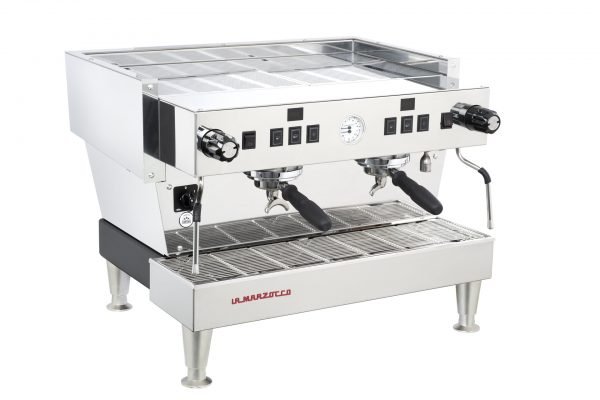 The Espresso Machine: Your Most Important Decision
Not all espresso machines are created equal. Not even close. Here’s what actually matters when choosing one for a commercial setting.
Number of Groups
Groups are the brewing heads — where the portafilter locks in. More groups means more drinks at once.
A 1-group machine is fine for a small office or very low-volume setting. Most coffee shops need a 2-group machine minimum. High-volume shops — think 300+ drinks per day — should look at 3-group machines.
At Coffee Loft, we carry everything from 1-group La Marzocco GS3 units at €6,500 to 3-group KB90s at €21,000. The right choice depends on your peak hour, not your daily average.
Boiler System
Single boiler — Brews and steams from the same boiler. Fine for home use, limiting for commercial. You’re always waiting for temperature to switch between brewing and steaming.
Heat exchanger — One boiler, but a separate circuit for brewing. Can brew and steam simultaneously. Good mid-range solution. Many Rocket models, like the Appartamento, use this system well — though Rocket also produces dual boiler machines for those who want full temperature control.
Dual boiler — Separate boilers for brewing and steam. Independent temperature control for each. This is what you want for any serious coffee operation. La Marzocco, Dalla Corte, and higher-end machines across our range use dual boiler systems.
Volumetric vs. Semi-Automatic
Volumetric machines dose water automatically — press a button, walk away, the machine stops when the programmed volume is reached. Semi-automatic machines require the barista to start and stop the shot manually.
For restaurants where the person making coffee is also plating desserts? Volumetric. For specialty coffee shops where baristas are dialling in shots throughout the day? Either works, but many prefer the control of semi-automatic.
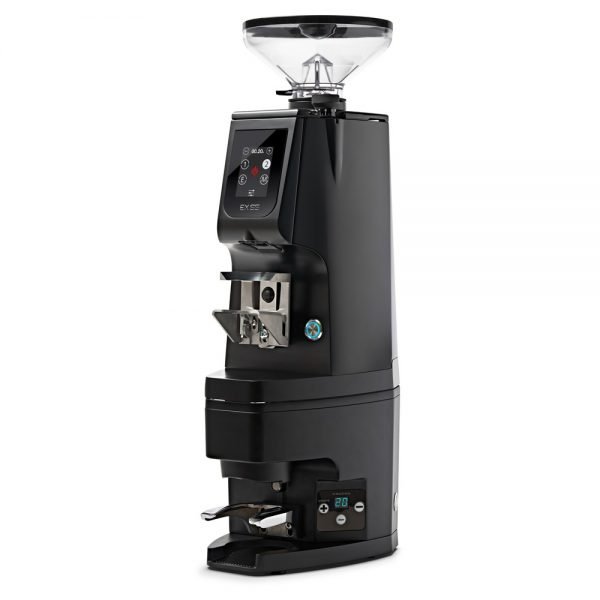 The Grinder: More Important Than You Think
Here’s something that surprises almost every new coffee shop owner: your grinder matters at least as much as your espresso machine. Maybe more.
A €15,000 La Marzocco with a bad grinder will produce worse coffee than a €4,000 machine paired with an excellent grinder. That’s not opinion — it’s physics. Grind consistency determines extraction, and extraction determines taste.
Why You Need a Dedicated Grinder
We hear this regularly: “But I thought espresso machines come with grinders?” or “Can’t I just get a super-automatic that does everything?”
Short answer: no. Professional espresso requires an extremely fine, extremely consistent grind. Super-automatic machines grind beans internally, but they don’t give you the precision or adjustability that a dedicated grinder provides. The coffee is decent, but it’s not specialty quality. It’s the difference between a microwave meal and cooking from scratch — both fill you up, but only one makes people come back.
At Coffee Loft, we carry five grinder brands: Eureka (33 models — our deepest range), Mazzer, Mahlkönig, Compak, and La Marzocco. Each has its strengths.
Flat Burrs vs. Conical Burrs
Flat burrs produce extremely uniform particle sizes. They’re the standard for commercial espresso because consistency equals consistency in the cup. Mahlkönig and most Eureka commercial models use flat burrs.
Conical burrs create a slightly less uniform grind but run cooler and quieter. They produce espresso with more body and a rounder mouthfeel. Mazzer is famous for their conical burr grinders.
For most commercial setups, flat burrs are the way to go. For home use or lower-volume settings, both work beautifully.
How to Match Your Grinder to Your Machine
Think of it like this: your machine is the engine, your grinder is the fuel pump. They need to work at the same pace.
A busy coffee shop with a La Marzocco KB90 needs a grinder that can dose 20g of espresso in under 3 seconds — a Mahlkönig E65S or Eureka Atom Specialty does this effortlessly. A Rocket Appartamento at home pairs perfectly with a smaller Eureka Mignon.
The general rule: spend at least 30–40% of your machine budget on the grinder. It’s never wasted money.
Water: Malta’s Hidden Coffee Challenge
Here’s something that most equipment guides won’t tell you, but we will, because we’re in Malta and this matters a lot.
Malta has hard water. Very hard water. The tap water in many areas has high mineral content and carbonate hardness, which is the worst combination for espresso machines.
Hard water causes scale buildup inside boilers, heat exchangers, and group heads. Left unchecked, it reduces machine performance, changes the taste of your coffee, and eventually causes expensive breakdowns. We’ve seen machines that needed major boiler work within two years because nobody installed proper water filtration.
What you need: A commercial water filtration system — not a household filter jug, but a proper inline filter designed for espresso machines. Budget €300–€600 for the filter setup, plus replacement cartridges every 6–12 months depending on volume. Ask us which system works best for your machine and location.
This isn’t optional in Malta. It’s the cheapest insurance you’ll ever buy for a machine worth thousands.
Electrical Requirements: Check Before You Sign the Lease
Before choosing a machine, make sure your space can handle it. In Malta, we use single-phase power with standard plugs. Most espresso machines we sell are configured for this, but it’s still worth checking that your electrical panel has enough capacity — especially if you’re running other kitchen equipment on the same circuit.
Some older buildings in Valletta and other historic areas may have outdated wiring that needs upgrading. A quick check by an electrician before signing your lease can save you from expensive surprises later.
Our advice: Have an electrician check your power supply before ordering equipment. It’s a 30-minute visit that could save you weeks of delays.
The Timeline: Why You Can’t Order Equipment Last Minute
This is the single biggest surprise for new coffee shop and restaurant owners. And honestly, it’s the reason we wrote this guide.
Restaurants and coffee shops often come to us wanting equipment immediately. “We’re opening in two weeks, we need a machine.” We understand the urgency, but professional coffee equipment isn’t sitting on a shelf waiting for you. Most of what we sell is built to order or shipped from European manufacturers.
Standard equipment (Rocket, Eureka, Fracino, Conti): Allow 5–6 weeks from order to delivery. Sometimes faster, sometimes longer — it depends on the manufacturer’s production schedule and shipping to Malta.
La Marzocco: Allow up to 6 months. Yes, six months. La Marzocco machines are built in Florence and the demand is enormous. Custom configurations (specific colours, group counts, accessories) can take even longer.
Dalla Corte and Modbar: Similar to La Marzocco — these are premium, made-to-order machines. Plan 3–6 months ahead.
The lesson: Order your equipment as early as possible. Ideally, this should be one of the first things you do after securing your location — not the last. You can sort out your menu, hire staff, and paint the walls while waiting for your machine. You can’t open without one.
The Budget: What a Complete Setup Actually Costs
Nobody likes surprises when it comes to money. Here’s what a realistic complete coffee setup looks like in Malta:
Entry-Level Coffee Shop Setup
- Espresso machine (Fracino or Conti 2-group): €3,500–€5,000
- Grinder (Eureka Atom or Mazzer): €800–€1,500
- Water filtration: €300–€500
- Barista tools (tamper, knock box, pitchers, scales): €200–€400
- Total: approximately €5,000–€7,500
Mid-Range Coffee Shop Setup
- Espresso machine (La Marzocco Linea Classic or Conti): €7,000–€12,000
- Primary grinder (Mahlkönig E65S or Eureka Atom W75): €1,800–€2,500
- Second grinder for decaf: €500–€1,000
- Water filtration: €400–€600
- Barista tools and accessories: €300–€500
- Total: approximately €10,000–€17,000
Premium Specialty Coffee Shop Setup
- Espresso machine (La Marzocco Linea PB, KB90, or Dalla Corte): €12,000–€21,000
- Primary grinder (Mahlkönig E65S or EK43): €1,800–€3,100
- Second grinder: €1,000–€2,000
- Water filtration system: €400–€600
- Full barista tool kit: €400–€600
- Total: approximately €16,000–€28,000
These numbers don’t include water filtration installation or any electrical work your space may need.
Why Buying from a Local Dealer Matters
We need to be honest about something: you can probably find some of these machines cheaper online. A quick search will show you retailers in Germany, the UK, or Spain offering lower prices.
Here’s what that lower price doesn’t include:
Warranty that works. Our equipment comes with a 12-month warranty. If something goes wrong, our workshop is in Valletta — bring your equipment to us and our technician will diagnose and fix it. We’re also always available for online consultations — you can reach us by phone or email and our technician will advise you on the spot. An online retailer in another country? You’re shipping your machine internationally for repair, paying for freight, and waiting weeks.
Setup guidance. Need help getting your machine up and running? We’ll walk you through everything — water connections, power requirements, grinder calibration, and initial setup. If you need advice on installation, our team is happy to guide you through the process so you get it right the first time. An online purchase gives you a machine in a box and a manual — the rest is up to you.
Ongoing service. Espresso machines need maintenance. Gaskets wear out, boilers need descaling, electronics occasionally need attention. We service everything we sell, and we know these machines inside out because we work with them every day.
Good to know: we also service equipment purchased elsewhere. If your machine needs attention, regardless of where you bought it, feel free to reach out — our technician is happy to help.
Ready to Talk?
Every coffee business is different. The best setup for a 50-seat restaurant in Sliema is completely different from a specialty takeaway in Valletta or a co-working space in St Julian’s.
You’re welcome to visit our showroom at 141 St. Nicholas Street, Valletta — just get in touch beforehand to book a time so we can give you our full attention. Drop us an email at vitalija@coffeeloft.shop or call +356 7909 7488 to arrange a visit.
Or browse our full equipment range online at coffeeloft.shop.
Coffee Loft — Equipment and tools for people who take coffee seriously.